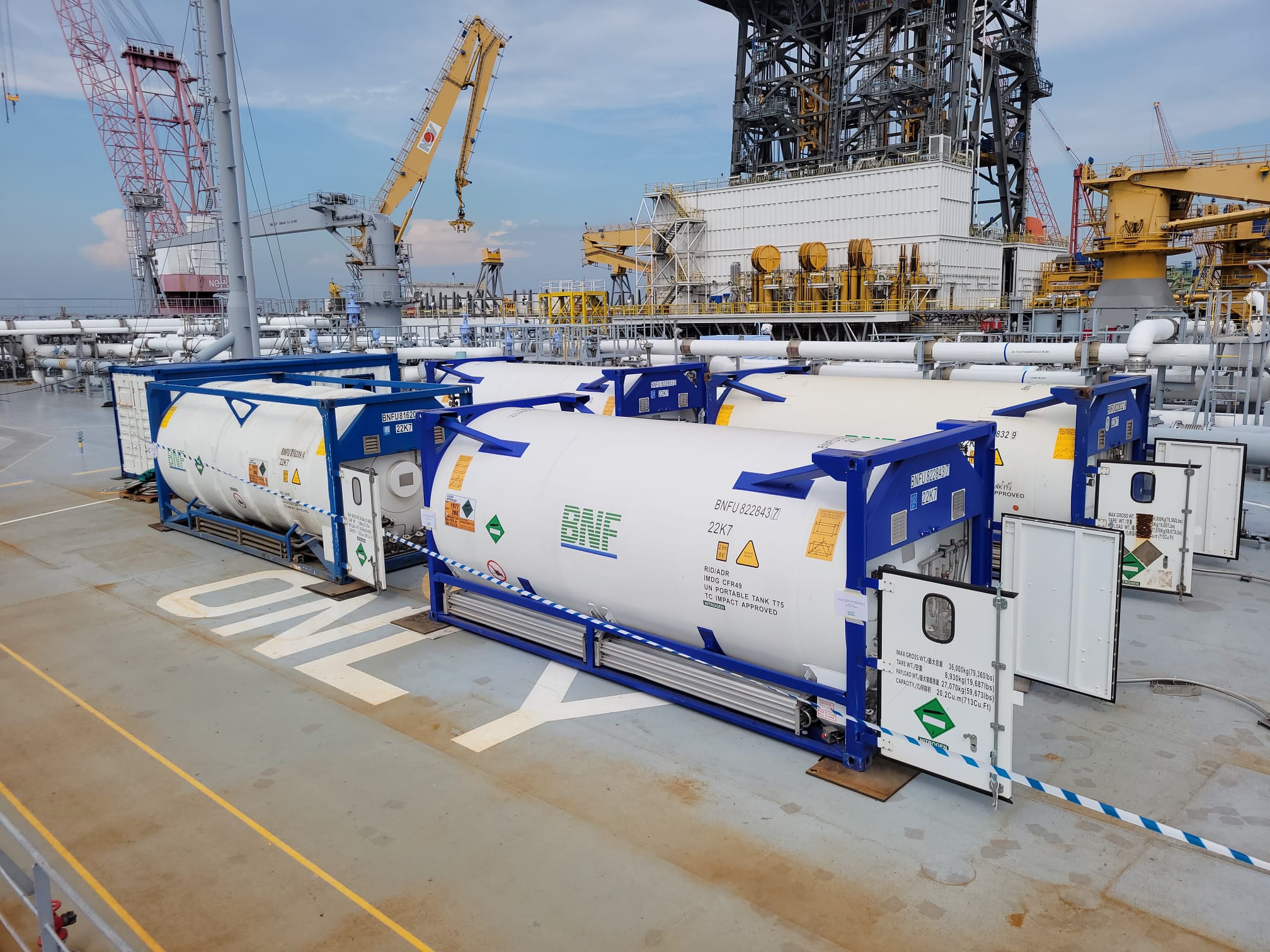
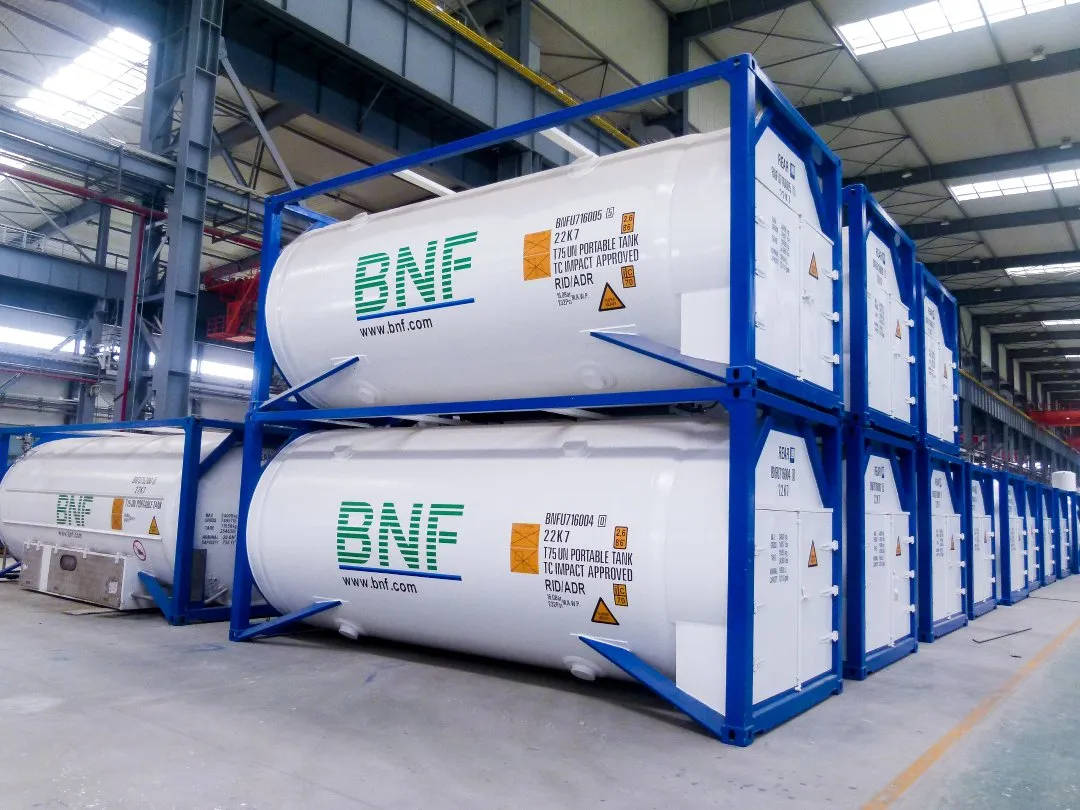
An ISO tank is a tank built into a standard container frame, so it moves by sea, road and rail like any other container. We run two types, and they do very different jobs. Picking the right one starts with the gas you need to move.
A T75 is a UN portable tank for gases carried as very cold liquids. Think liquid nitrogen, liquid oxygen, liquid argon, liquid CO₂, ethylene and LNG.
The tank is really two vessels, one inside the other. A stainless steel inner vessel holds the cargo. A carbon steel outer vessel surrounds it, and the space between them is held under vacuum with multi-layer insulation. That vacuum is what keeps heat out and the cargo cold for the length of the journey.
Because no insulation is perfect, a cryogenic cargo slowly warms and its pressure slowly rises. So with a T75, timing matters. The route, the transit time and how quickly the tank is unloaded at the other end all need to fit the cargo.
A T50 is a UN portable tank for liquefied gases that stay liquid under pressure at normal temperatures. It carries cargoes such as propane, butane, propylene, sulphur dioxide and refrigerants like R-134a and R-410A.
There is no vacuum jacket here. Instead, the shell is built to hold the vapour pressure of the cargo safely across the temperatures it will meet on the way. The gas stays liquid because it is kept under pressure, not because it is kept cold.
That makes the T50 simpler to plan around. Without a cryogenic cargo warming in transit, timing is less critical, though fill limits still depend on the product and the temperatures on the route.
Start with the gas. If it is carried cold, you need a T75. If it is carried under pressure, you need a T50. Some gases can travel either way, and then the choice comes down to how the gas will be stored and used at the other end.
Next, look at the volume. Each tank has a maximum fill for each product, set by volume and by weight, and that figure tells you how many tanks the job needs.
Then look at the route. Every tank in our fleet is built and certified for international transport by sea, road and rail, but the route still decides transit time, and for a cryogenic cargo that matters.
Finally, look at how long you need the tank. Some customers lease for a single project. Others keep tanks on hire for years.
Every T75 and T50 we lease is ours. We own the tanks, and our own team maintains them, prepares them for inspection and checks them on hire and off hire. You deal with one company from the first enquiry to the day the tank comes back.
If you are not sure which tank fits your cargo, tell us the gas, the volume and the route. We will recommend the right tank and confirm the figures with your quote.